
Launch & Growth
The 13-Week Cash-Flow Calendar Every Product Business Should Build
Map supplier deposits, payroll, production, wholesale receipts, ecommerce payouts, tax reserves, and owner decisions across thirteen practical weeks.
Profit answers whether the business creates value over a period. A cash calendar answers whether money is available on the Tuesday a supplier deposit or payroll must clear. Product businesses need both because inventory is often paid for weeks before it becomes customer cash.
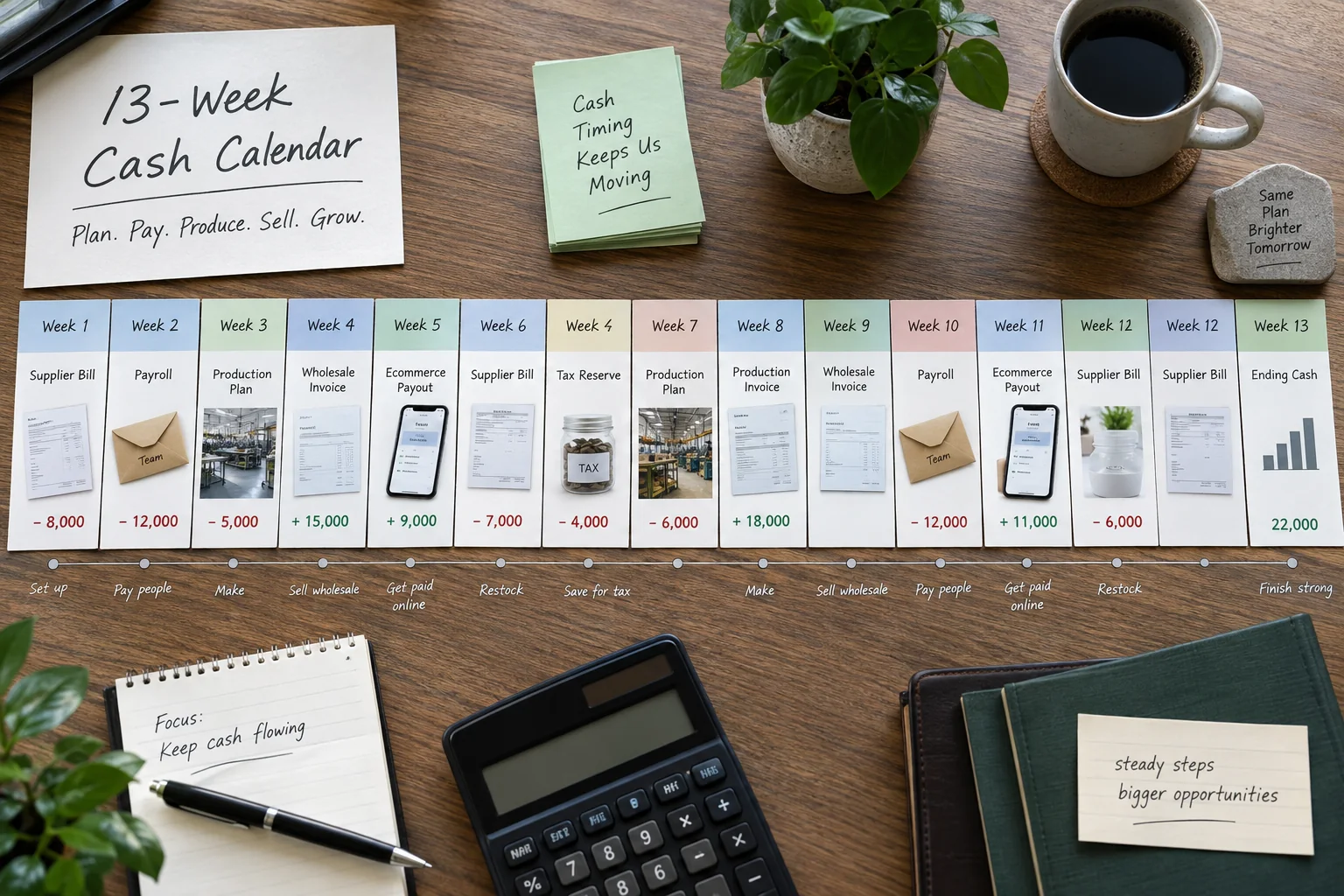
Thirteen weeks is long enough to expose purchase, production, wholesale, and tax timing while remaining close enough for concrete dates. The calendar is not a complex financial forecast. It is a weekly list of starting cash, credible receipts, committed payments, likely operating payments, reserves, and ending cash.
The purpose is earlier decisions. A gap seen six weeks ahead can be addressed through purchase timing, deposits, collections, production sequence, spending, or financing. A gap discovered at the bank is an emergency.
The quick answer
The outcome is a rolling thirteen-week view with dated cash commitments, confidence labels, warning thresholds, and actions that occur before the shortage. Begin with Reconcile bank cash, unpaid bills, open purchase orders, payroll dates, tax obligations, customer deposits, processor payouts, invoices, planned batches, and major discretionary spending. The first operating priorities are start with usable cash and place receipts by likely date; the working system then has to support place committed outflows, connect inventory and production, set triggers before the low point. Keep the scope narrow enough that the decision can be tested with real evidence instead of debated through general opinions.
What this looks like in a real maker business
A snack company records a profitable wholesale month but struggles to fund the next run. The retailer pays net 45 after delivery, while ingredients, packaging, payroll, and freight are paid before shipment. A thirteen-week calendar shows the exact low-cash week and lets the founder negotiate a deposit, stage packaging, and delay a nonessential launch without missing payroll.
The practical playbook
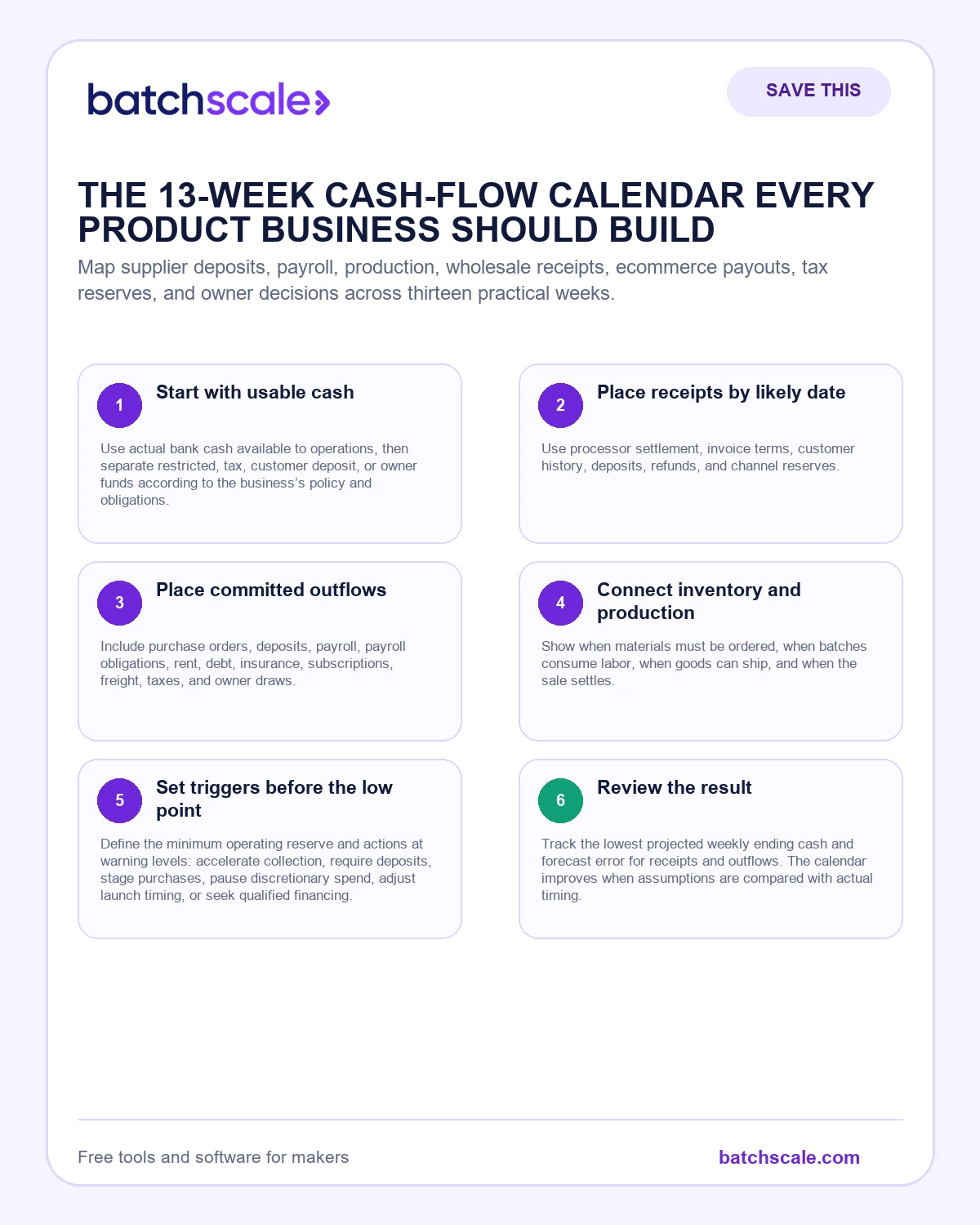
Start with usable cash
Use actual bank cash available to operations, then separate restricted, tax, customer deposit, or owner funds according to the business’s policy and obligations. Do not begin with total account balance if part is already spoken for.
Put it to work: Reconcile the opening balance to the bank and outstanding transactions.
Place receipts by likely date
Use processor settlement, invoice terms, customer history, deposits, refunds, and channel reserves. A sale date is not always a cash date.
Put it to work: List receipts by week and mark confidence rather than shifting uncertainty silently.
Place committed outflows
Include purchase orders, deposits, payroll, payroll obligations, rent, debt, insurance, subscriptions, freight, taxes, and owner draws. Put them on the week money is expected to leave.
Put it to work: Review open commitments and recurring payments, not memory.
Connect inventory and production
Show when materials must be ordered, when batches consume labor, when goods can ship, and when the sale settles. This exposes the cash conversion cycle behind growth.
Put it to work: Estimate the cycle with the cash conversion calculator.
Set triggers before the low point
Define the minimum operating reserve and actions at warning levels: accelerate collection, require deposits, stage purchases, pause discretionary spend, adjust launch timing, or seek qualified financing.
Put it to work: Assign an owner and decision date for every projected breach.
What can go wrong
A cash calendar is not accounting, tax, lending, or legal advice. Preserve accurate books and obtain qualified guidance. Avoid counting uncertain financing, late receivables, or hoped-for launches as committed cash.
A useful safeguard is to keep the original source record beside the interpretation. If an order, count, supplier date, batch result, customer message, or payment changes, update the decision and preserve why it changed. This prevents a confident dashboard from drifting away from the physical business.
The number that keeps this honest
Track the lowest projected weekly ending cash and forecast error for receipts and outflows. The calendar improves when assumptions are compared with actual timing.
Use the number as a decision signal, not a performance weapon. Review the definition, compare similar periods, and pair it with quality and customer evidence. A metric becomes dangerous when people improve the displayed result by moving work, cost, or failure outside the measurement.
A simple 30-day implementation
Week 1: establish the baseline
Gather the records described above and keep uncertainty visible. Use actual orders, batches, counts, supplier confirmations, and payment records wherever possible. Mark estimates instead of polishing them into false facts. Choose one product, channel, or workflow narrow enough to finish in a week. A completed small baseline teaches more than a company-wide workbook nobody trusts.
Week 2: change one operating rule
Translate the first two playbook steps into a rule with an owner, trigger, input, decision, and expected output. Save the previous method. Explain the change to everyone whose work or promise is affected. If the rule touches safety, compliance, employment, tax, contracts, or regulated claims, pause for qualified guidance before using a general article as authority.
Week 3: run the rule in real work
Use the rule through a normal cycle. Record exceptions when they happen; do not repair the record after the fact. Keep customer commitments and required controls intact. One exception may be ordinary variation. Repeated exceptions usually mean the threshold, instruction, source data, authority, or capacity assumption needs revision.
Week 4: review the evidence
Compare the baseline with the metric in this guide. Ask what improved, what moved somewhere else, and what new burden appeared. Keep the rule, revise it, or remove it. Write the decision, owner, and next review date. That short history becomes operating memory and prevents the same debate from restarting whenever the founder is tired.
When connected software becomes useful
Spreadsheets and checklists are excellent for learning a method. They become fragile when the same product, formula, material, batch, order, customer, and cost must be updated in several places. Duplicate entry creates version disagreement; delayed entry makes reports look precise while the floor works from different facts.
Connected software should not automate confusion. It should preserve the current product version, show available and committed inventory, connect production with actual material and yield, carry costs into channel decisions, record who changed what, and make exceptions visible. Start with the decision that currently requires the most reconciliation. Add the next workflow only after the first source of truth is dependable.
Questions to ask before you scale the change
- Can a trained person explain the rule and the reason behind it?
- Is the required source data available at the moment the decision is made?
- Does the rule protect product quality, customer expectations, and applicable obligations?
- What evidence would prove the change is helping rather than moving cost elsewhere?
- Who owns an exception, and how quickly must they respond?
- Can the business export the records and reconstruct what happened later?
Growth becomes calmer when decisions leave a trail. The objective is not more administration. It is fewer avoidable surprises and a business that can repeat what works.
Related tools and reading
The bottom line
The outcome is a rolling thirteen-week view with dated cash commitments, confidence labels, warning thresholds, and actions that occur before the shortage. Choose one product or workflow, establish the baseline, and make one observable change. Review the result after a real cycle. Clear evidence, a responsible owner, and a next review date will outperform a dramatic overhaul that the business cannot sustain.
Explore all free tools for makers, browse the Batch Scale resource center, or see how Batch Scale connects costing, inventory, production, orders, and customers.