
Shipping & E-Commerce
Subscription Box Churn: Fix the Economics Before You Add More Surprises
Model box contribution, acquisition payback, skipped shipments, churn, contents planning, and customer control before scaling a subscription program.
A subscription business can grow shipments while becoming less healthy. New subscribers enter through a discount, first boxes receive expensive extras, shipping rises, and cancellations appear after the novelty fades. Revenue looks recurring; contribution and customer trust are not guaranteed to recur with it.
Churn is not one problem. Customers may leave because the product did not fit, value became repetitive, timing was wrong, skipping was difficult, a payment failed, or expectations were unclear. Adding more surprise can raise cost without addressing any of those causes.
Build the program around a repeatable customer job, visible control, and complete unit economics. A smaller retained base can be more valuable than constant acquisition into an avoidable leak.
The quick answer
The outcome is a subscription model whose core box, controls, replenishment, and acquisition spend remain healthy at realistic retention—not idealized lifetime value. Begin with Export subscribers by start month, plan, acquisition source, discount, shipments, skips, cancellations, reason, refunds, and contribution. Use at least six months when available. The first operating priorities are calculate contribution per shipment and measure churn by tenure and reason; the working system then has to support design a dependable core, give customers control, plan inventory to retained demand. Keep the scope narrow enough that the decision can be tested with real evidence instead of debated through general opinions.
What this looks like in a real maker business
A snack subscription doubles subscribers through a half-price first box. By month three, customers report duplicate flavors and too much product. The business adds pause and preference choices, reduces first-box excess, standardizes the profitable core, and uses limited discovery items selectively. Acquisition slows, but contribution per retained subscriber and fulfillment reliability improve.

The practical playbook
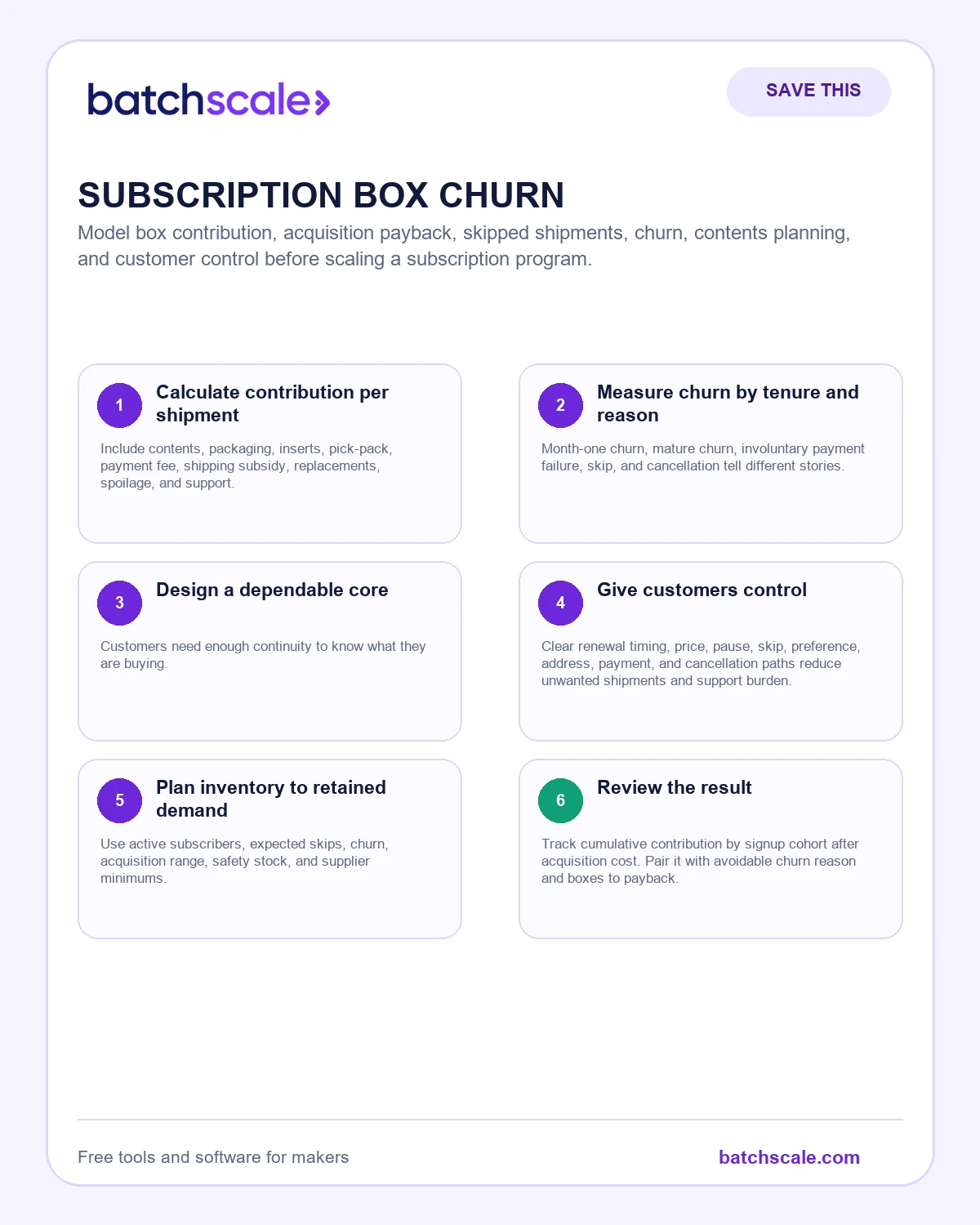
Calculate contribution per shipment
Include contents, packaging, inserts, pick-pack, payment fee, shipping subsidy, replacements, spoilage, and support. First-box gifts and discounts belong in acquisition cost, not nowhere.
Put it to work: Model the program with the subscription economics calculator.
Measure churn by tenure and reason
Month-one churn, mature churn, involuntary payment failure, skip, and cancellation tell different stories. A single monthly rate hides where the experience breaks.
Put it to work: Ask one concise cancellation question and connect the response with tenure, plan, and box version.
Design a dependable core
Customers need enough continuity to know what they are buying. Novelty should add value around a stable job, specification, or curation standard rather than becoming uncontrolled purchasing.
Put it to work: Define what every box must deliver before selecting surprise items.
Give customers control
Clear renewal timing, price, pause, skip, preference, address, payment, and cancellation paths reduce unwanted shipments and support burden. Respect applicable subscription and consumer requirements.
Put it to work: Complete every self-service path on a phone and remove unnecessary contact barriers.
Plan inventory to retained demand
Use active subscribers, expected skips, churn, acquisition range, safety stock, and supplier minimums. Overbuying for hoped-for growth converts a retention problem into obsolete inventory.
Put it to work: Build base, high, and low shipment forecasts before committing unique components.
What can go wrong
Do not hide cancellation, use prechecked add-ons, or rely on confusing renewal language. Rules vary by jurisdiction and channel; obtain qualified guidance. Preserve consent, notice, and transaction records.
A useful safeguard is to keep the original source record beside the interpretation. If an order, count, supplier date, batch result, customer message, or payment changes, update the decision and preserve why it changed. This prevents a confident dashboard from drifting away from the physical business.
The number that keeps this honest
Track cumulative contribution by signup cohort after acquisition cost. Pair it with avoidable churn reason and boxes to payback.
Use the number as a decision signal, not a performance weapon. Review the definition, compare similar periods, and pair it with quality and customer evidence. A metric becomes dangerous when people improve the displayed result by moving work, cost, or failure outside the measurement.
A simple 30-day implementation
Week 1: establish the baseline
Gather the records described above and keep uncertainty visible. Use actual orders, batches, counts, supplier confirmations, and payment records wherever possible. Mark estimates instead of polishing them into false facts. Choose one product, channel, or workflow narrow enough to finish in a week. A completed small baseline teaches more than a company-wide workbook nobody trusts.
Week 2: change one operating rule
Translate the first two playbook steps into a rule with an owner, trigger, input, decision, and expected output. Save the previous method. Explain the change to everyone whose work or promise is affected. If the rule touches safety, compliance, employment, tax, contracts, or regulated claims, pause for qualified guidance before using a general article as authority.
Week 3: run the rule in real work
Use the rule through a normal cycle. Record exceptions when they happen; do not repair the record after the fact. Keep customer commitments and required controls intact. One exception may be ordinary variation. Repeated exceptions usually mean the threshold, instruction, source data, authority, or capacity assumption needs revision.
Week 4: review the evidence
Compare the baseline with the metric in this guide. Ask what improved, what moved somewhere else, and what new burden appeared. Keep the rule, revise it, or remove it. Write the decision, owner, and next review date. That short history becomes operating memory and prevents the same debate from restarting whenever the founder is tired.
When connected software becomes useful
Spreadsheets and checklists are excellent for learning a method. They become fragile when the same product, formula, material, batch, order, customer, and cost must be updated in several places. Duplicate entry creates version disagreement; delayed entry makes reports look precise while the floor works from different facts.
Connected software should not automate confusion. It should preserve the current product version, show available and committed inventory, connect production with actual material and yield, carry costs into channel decisions, record who changed what, and make exceptions visible. Start with the decision that currently requires the most reconciliation. Add the next workflow only after the first source of truth is dependable.
Questions to ask before you scale the change
- Can a trained person explain the rule and the reason behind it?
- Is the required source data available at the moment the decision is made?
- Does the rule protect product quality, customer expectations, and applicable obligations?
- What evidence would prove the change is helping rather than moving cost elsewhere?
- Who owns an exception, and how quickly must they respond?
- Can the business export the records and reconstruct what happened later?
Growth becomes calmer when decisions leave a trail. The objective is not more administration. It is fewer avoidable surprises and a business that can repeat what works.
Related tools and reading
The bottom line
The outcome is a subscription model whose core box, controls, replenishment, and acquisition spend remain healthy at realistic retention—not idealized lifetime value. Choose one product or workflow, establish the baseline, and make one observable change. Review the result after a real cycle. Clear evidence, a responsible owner, and a next review date will outperform a dramatic overhaul that the business cannot sustain.
Explore all free tools for makers, browse the Batch Scale resource center, or see how Batch Scale connects costing, inventory, production, orders, and customers.