
Operations & Growth
Too Many Options Are Costing You: The Hidden Price of Variant Explosion
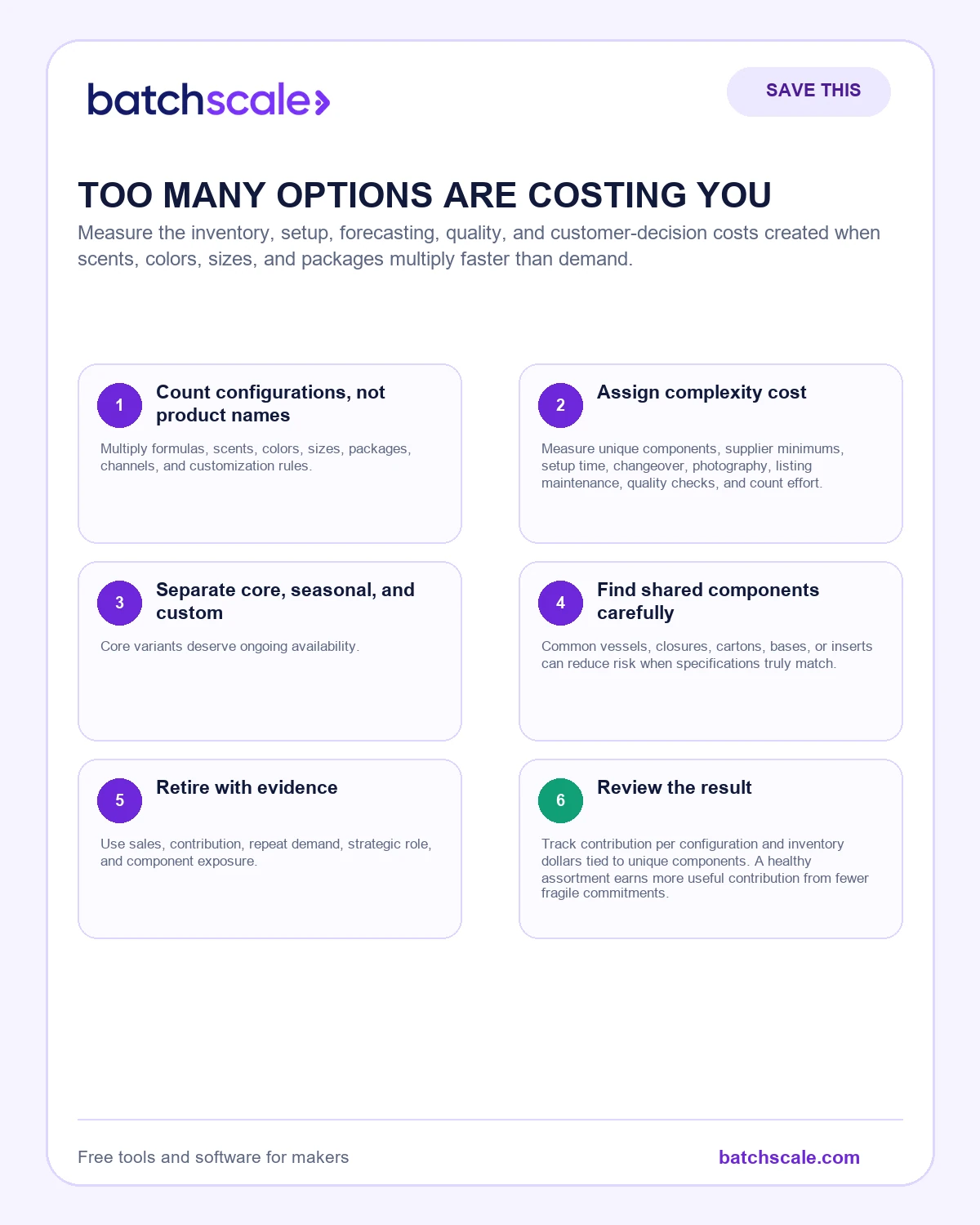
Measure the inventory, setup, forecasting, quality, and customer-decision costs created when scents, colors, sizes, and packages multiply faster than demand.
One new scent feels harmless. So does a second size, a seasonal color, a different closure for wholesale, and a gift sleeve for the holidays. Then every choice multiplies the others. Five scents across three sizes and two packages are not ten options; they are thirty configurations to photograph, cost, forecast, label, count, make, and explain.
Variant explosion is dangerous because much of its cost does not appear on the material bill. It lives in small purchase orders, partial cases, changeovers, slow inventory, label mistakes, customer hesitation, and founder attention. The catalog can look exciting while cash and capacity fragment.
The answer is not a joyless one-product business. It is intentional variety: enough difference to serve real demand, with rules that prevent every creative idea from becoming permanent operational infrastructure.
The quick answer
The outcome is a clear assortment architecture: dependable core, bounded seasonal creativity, and custom work priced for the complexity it creates. Begin with Export every active SKU and option, then add ninety-day units, contribution, unique components, stock value, setup minutes, and last sale date. The first operating priorities are count configurations, not product names and assign complexity cost; the working system then has to support separate core, seasonal, and custom, find shared components carefully, retire with evidence. Keep the scope narrow enough that the decision can be tested with real evidence instead of debated through general opinions.
What this looks like in a real maker business
A soap company carries twelve scents, three bar sizes, gift wrap, and two label styles. Only fourteen combinations sell consistently, but purchasing must support seventy-two. Stockouts happen on popular cartons while slow labels fill bins. The maker converts six scents to rotating releases, standardizes the core size, and offers gift wrap as an order-level service. Revenue holds while count accuracy and production speed improve.

The practical playbook
Count configurations, not product names
Multiply formulas, scents, colors, sizes, packages, channels, and customization rules. Include channel-specific labels and bundles. The total reveals the real number of configurations the team must control.
Put it to work: Create one row per sellable configuration and mark whether it sold in the last ninety days.
Assign complexity cost
Measure unique components, supplier minimums, setup time, changeover, photography, listing maintenance, quality checks, and count effort. A low-volume variant can be expensive even when its ingredient margin looks attractive.
Put it to work: Add ten minutes of administrative and setup work where the business currently treats it as free.
Separate core, seasonal, and custom
Core variants deserve ongoing availability. Seasonal variants need launch and exit dates. Custom choices should have defined lead time, price, and approval. Categories prevent every option from inheriting a permanent stock promise.
Put it to work: Label every configuration with one lifecycle and a review date.
Find shared components carefully
Common vessels, closures, cartons, bases, or inserts can reduce risk when specifications truly match. Standardization should never erase safety, compatibility, performance, or labeling requirements.
Put it to work: Identify the component whose standardization removes the most purchase orders without changing the customer result.
Retire with evidence
Use sales, contribution, repeat demand, strategic role, and component exposure. Communicate final-order dates and replacements honestly. Do not keep a variant forever because one vocal customer might return.
Put it to work: Run the assortment through the product mix optimizer and choose the first controlled retirement.
What can go wrong
Do not cut variants using revenue alone. A small option may unlock an important retailer, accessibility need, or high-contribution custom service. Conversely, a popular option may create damaging minimums. Record the role before deciding.
A useful safeguard is to keep the original source record beside the interpretation. If an order, count, supplier date, batch result, customer message, or payment changes, update the decision and preserve why it changed. This prevents a confident dashboard from drifting away from the physical business.
The number that keeps this honest
Track contribution per configuration and inventory dollars tied to unique components. A healthy assortment earns more useful contribution from fewer fragile commitments.
Use the number as a decision signal, not a performance weapon. Review the definition, compare similar periods, and pair it with quality and customer evidence. A metric becomes dangerous when people improve the displayed result by moving work, cost, or failure outside the measurement.
A simple 30-day implementation
Week 1: establish the baseline
Gather the records described above and keep uncertainty visible. Use actual orders, batches, counts, supplier confirmations, and payment records wherever possible. Mark estimates instead of polishing them into false facts. Choose one product, channel, or workflow narrow enough to finish in a week. A completed small baseline teaches more than a company-wide workbook nobody trusts.
Week 2: change one operating rule
Translate the first two playbook steps into a rule with an owner, trigger, input, decision, and expected output. Save the previous method. Explain the change to everyone whose work or promise is affected. If the rule touches safety, compliance, employment, tax, contracts, or regulated claims, pause for qualified guidance before using a general article as authority.
Week 3: run the rule in real work
Use the rule through a normal cycle. Record exceptions when they happen; do not repair the record after the fact. Keep customer commitments and required controls intact. One exception may be ordinary variation. Repeated exceptions usually mean the threshold, instruction, source data, authority, or capacity assumption needs revision.
Week 4: review the evidence
Compare the baseline with the metric in this guide. Ask what improved, what moved somewhere else, and what new burden appeared. Keep the rule, revise it, or remove it. Write the decision, owner, and next review date. That short history becomes operating memory and prevents the same debate from restarting whenever the founder is tired.
When connected software becomes useful
Spreadsheets and checklists are excellent for learning a method. They become fragile when the same product, formula, material, batch, order, customer, and cost must be updated in several places. Duplicate entry creates version disagreement; delayed entry makes reports look precise while the floor works from different facts.
Connected software should not automate confusion. It should preserve the current product version, show available and committed inventory, connect production with actual material and yield, carry costs into channel decisions, record who changed what, and make exceptions visible. Start with the decision that currently requires the most reconciliation. Add the next workflow only after the first source of truth is dependable.
Questions to ask before you scale the change
- Can a trained person explain the rule and the reason behind it?
- Is the required source data available at the moment the decision is made?
- Does the rule protect product quality, customer expectations, and applicable obligations?
- What evidence would prove the change is helping rather than moving cost elsewhere?
- Who owns an exception, and how quickly must they respond?
- Can the business export the records and reconstruct what happened later?
Growth becomes calmer when decisions leave a trail. The objective is not more administration. It is fewer avoidable surprises and a business that can repeat what works.
Related tools and reading
The bottom line
The outcome is a clear assortment architecture: dependable core, bounded seasonal creativity, and custom work priced for the complexity it creates. Choose one product or workflow, establish the baseline, and make one observable change. Review the result after a real cycle. Clear evidence, a responsible owner, and a next review date will outperform a dramatic overhaul that the business cannot sustain.
Explore all free tools for makers, browse the Batch Scale resource center, or see how Batch Scale connects costing, inventory, production, orders, and customers.