
Markets & Growth
Build a Wholesale Sample Box Buyers Can Actually Evaluate
Help a retail buyer assess product, economics, shelf fit, operations, and the next step without sending an expensive box of disconnected gifts.
A wholesale sample box is not a customer gift box with a line sheet tucked inside. The buyer is evaluating whether the product fits an assortment, survives handling, carries workable economics, can be reordered, meets documentation expectations, and arrives from a business capable of keeping the promise.
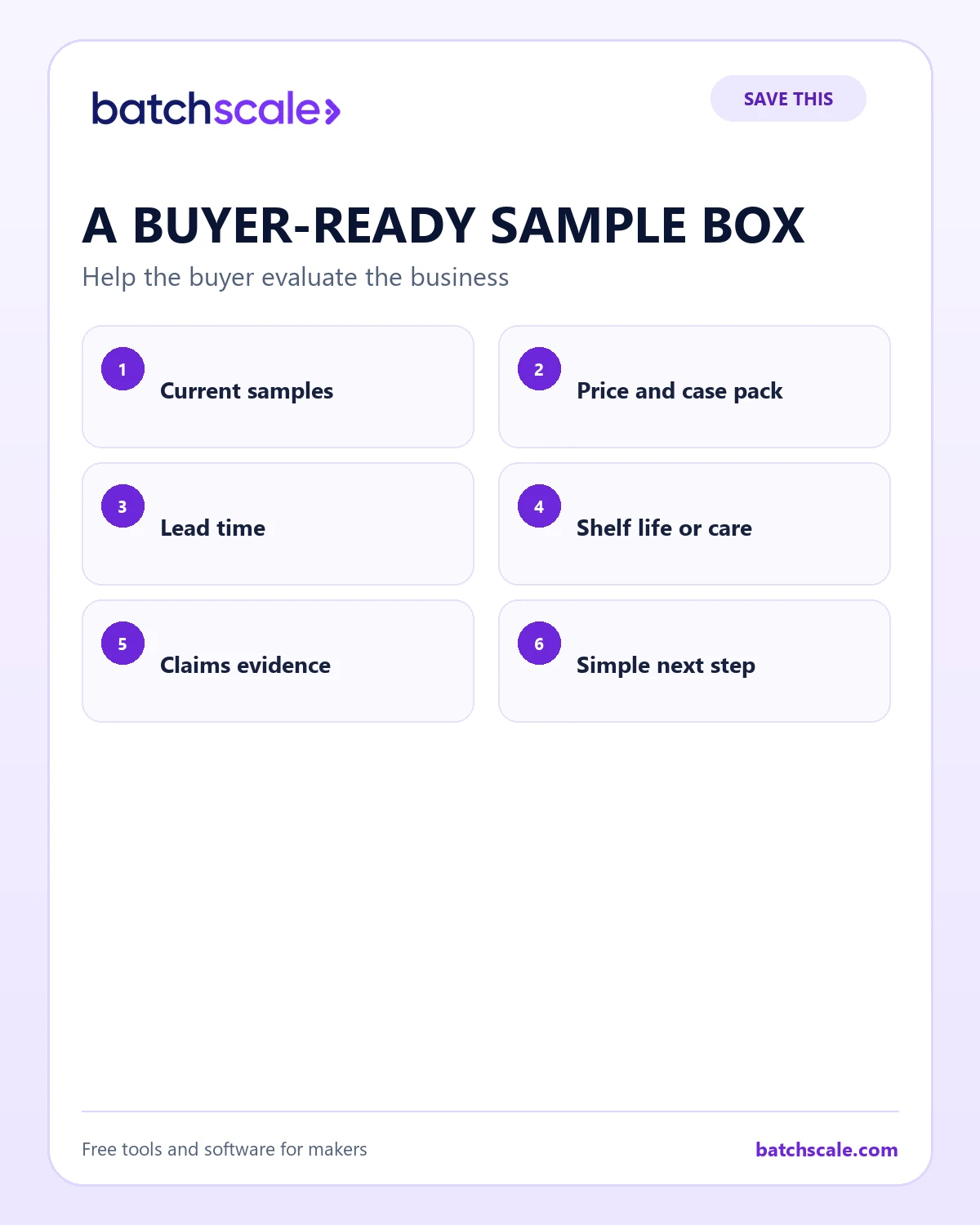
Sending every fragrance, flavor, or color creates work for the buyer and expense for the maker. A stronger box curates the current wholesale offer, provides production-representative samples, and makes the decision path obvious. It is generous with useful evidence and restrained with decoration.
The goal is not to impress the buyer with how much you can send. It is to make the right evaluation easier.
The real-world pattern
A candle brand sends eight scents in custom gift packaging. The buyer likes them but cannot find case packs, lead times, shelf dimensions, or which scents will remain available. Follow-up stalls. The revised sample box contains three core products in actual retail packaging, a concise wholesale overview, case and reorder terms, product evidence, shipping dimensions, and one link for current ordering information.

The practical playbook
Confirm interest and audience
Whenever possible, ask what category, price, customer, season, space, and review process the buyer is working with before shipping.
Put it to work: Record permission, recipient, address, timing, and requested materials; do not send unsolicited perishables or sensitive products.
Curate current samples
Choose production-representative core products that demonstrate the line. Identify sample-only packaging or formulation differences explicitly.
Put it to work: Inspect and record sample lots, shelf life or care, and the exact current sellable version.
Show the economics clearly
Provide wholesale price, suggested retail where appropriate, case pack, opening and reorder minimums, payment, shipping, and expected lead time.
Put it to work: Verify order contribution with the wholesale profit calculator before printing terms.
Provide decision evidence
Include dimensions, materials, ingredients, allergens, testing, claims support, barcodes, certifications, insurance, or policies relevant to the product and buyer.
Put it to work: Share only accurate current evidence and give the buyer a clear channel for due diligence questions.
Make follow-up simple
State availability, the next action, response time, and how samples are handled. Avoid trapping the buyer in a long automated sequence.
Put it to work: Schedule one respectful follow-up tied to the stated review window and record the outcome.
What to watch
Confirm retailer-specific requirements before implying readiness. Protect confidential pricing appropriately, avoid unsupported claims, and follow carrier rules for liquids, perishables, fragrance, alcohol, batteries, or other restricted contents.
The number that keeps this honest
Track qualified buyer conversations and orders per sample box, along with total sample, preparation, and freight cost. A high response rate from poorly fitting buyers is not efficient acquisition.
Put the lesson to work without rebuilding everything
Choose one current product and one recent operating cycle. Gather the source evidence before changing the system: purchase records, actual material quantities, sellable yield, hands-on time, order history, refunds, defects, customer questions, and the cash that moved. Estimates are acceptable when clearly labeled, but replace the highest-impact estimate first. A small maker does not need perfect data; the business needs numbers reliable enough to support the next decision.
Write the decision in plain language. “Improve inventory” is a project with no finish line. “Set a reorder trigger for the vessel that can stop our bestseller before Friday” can be completed and tested. Name the product, owner, trigger, action, and review date. Use a checklist or spreadsheet if that is sufficient. Add software only when the same information must stay connected across orders, materials, formulas, production, purchasing, and more than one person.
Run a seven-day evidence sprint
On day one, document the current method without defending it. On day two, calculate the baseline result. On day three, identify the earliest point where information becomes uncertain or work begins to wait. On days four and five, make the smallest useful control: a specification, decision rule, capacity limit, cost field, status, template, or quality check. On day six, run it through a real order or representative batch. On day seven, compare the result and decide whether to keep, revise, or remove the control.
The sprint should answer one question, not digitize the company. Record unintended consequences. A faster packout that increases damage is not an improvement. A lower material price that demands too much cash or produces inconsistent batches is not automatically a saving. A popular offer that requires unpaid founder labor is not automatically a winner. Look at the entire promise from purchasing through customer acceptance.
Keep a decision-grade scorecard
Most topics in this guide can be monitored with a short weekly scorecard:
- demand: qualified inquiries, orders, units, conversion, and repeat behavior;
- economics: net revenue, sellable unit cost, contribution, and contribution per constrained hour;
- delivery: promised versus actual completion and the age of open work;
- quality: first-pass yield, defects, rework, replacements, and the reason for each exception;
- inventory: available, committed, held, incoming, and days of practical coverage;
- cash: money committed before delivery, expected receipts, and obligations that are not spendable profit.
Not every business needs every measure. Choose the few that can change an action this week. Define each measure so the number cannot quietly change meaning. Compare normal cycles rather than a launch-day peak with a quiet Tuesday. Trends become useful only when the underlying definitions remain stable.
Build a rule for the tired version of you
A useful operating rule still works when the founder is busy. Write it as an if-then statement: if available stock reaches the reorder point, create the purchase decision; if requested customization exceeds the included revision, pause and re-quote; if practical capacity exceeds the agreed threshold, offer a later window; if a critical quality check fails, hold the affected work and investigate before release.
Test the rule against a recent surprise. Would it have prevented the late order, weak margin, shortage, or confusing customer exchange? If not, make the trigger more specific. If it creates ceremony around low-risk work, make it lighter. Good systems are not collections of forms. They make the correct action easier to recognize at the moment it matters.
Know when the system is ready to grow
Expansion should be earned by evidence: repeated full-price demand, a complete cost that pays sustainable labor, stable quality, a funded replenishment cycle, and a process that does not require emergency intervention every time. Before adding products, channels, equipment, or staff, name the constraint the investment will relieve and the result that will prove it worked.
Also define a stop or revision rule. Decide the maximum cash, time, defect rate, or delivery risk you will accept before pausing. This does not make the business less ambitious. It protects the resources required for the next good experiment. A clear no is often the system that preserves a better yes.
Questions for the next operating review
Before closing the review, ask whether the current offer and the current process describe the same promise. Marketing may still show an old package, quantity, lead time, option, or result after production has changed. Purchasing may use a new component that has not reached the specification. A customer-service reply may create an exception the schedule never received. Walk one recent order from the page the customer saw through the materials, batch, inspection, packout, delivery, and payment. Correct the earliest mismatch rather than adding another downstream reminder.
Then test the decision under three conditions: normal demand, a credible peak, and a disruption. The peak is not an imaginary viral month; it is the largest scenario supported by an event, wholesale conversation, seasonal history, preorder count, or campaign plan. The disruption should reflect a real vulnerability such as a long-lead package, unavailable founder skill, lower yield, carrier delay, or rejected material. Decide in advance which quantity, date, substitute, allocation, or communication rule changes in each condition.
Finally, review the human load. Count the steps that require memory, private messages, repeated copying, after-hours rescue, or one person's approval. Decide which should be removed, standardized, delegated, or made visible. Do not automate an unsafe or unclear decision merely because it repeats. Establish the rule and evidence first, then use automation to carry reliable information between steps.
Before the next cycle begins, make the change observable. Save the old baseline, the new rule, the person responsible, and the date when the team will review the outcome. Tell affected customers or partners when the change alters a promise, lead time, quantity, specification, or price. During the cycle, capture exceptions without treating every exception as a reason to abandon the rule. At review time, separate normal variation from a recurring failure. Keep the change when it improves the intended result without moving unacceptable cost or risk somewhere else. Revise it when the direction is right but the trigger, threshold, or instruction is weak. Remove it when it adds work without improving a decision. This simple record creates a reusable operating memory and gives future teammates the reason behind the process, not only the latest version of a checklist.
The review is complete when it produces an owner, action, and date. Keep a short record of the decision and the result after the next cycle. That history prevents the business from reopening the same debate every month and turns ordinary operations into a durable body of knowledge. Share the rule with everyone affected, confirm that they can follow it with the information available, and revise any instruction that depends on unspoken founder knowledge.
The bottom line
The purpose of operations is not to make a small business feel corporate. It is to protect the product, the customer, the cash, and the people doing the work. Choose one action from this guide, assign it to a real product and date, and review the evidence after the next cycle. Consistent learning compounds faster than dramatic reinvention.
Explore the complete library of free tools for makers or see how Batch Scale connects the work.