
Operations & Growth
AI Can Copy the Look. It Can't Copy the Maker.
In a market flooded with instant imitation, the most defensible advantage is the human system behind the product: judgment, provenance, consistency, and care.
A machine can generate a hundred plausible candle labels before lunch. A marketplace seller can copy a trending color palette in a weekend. A factory can imitate the silhouette of a handmade cup and put it on a shelf for less than your material cost. If your advantage is only the look, the next few years will feel frightening.
But customers do not keep a favorite mug because its outline was statistically fashionable. They remember the potter who made the handle fit a real hand. They return to the sauce maker who adjusted a pepper blend without losing the flavor they loved. They recommend the soap studio that explained why a batch looked different and made the situation right. The defensible part of a maker business is not a mood board. It is the accumulated judgment behind the object.
Etsy's 2026 trend reporting describes a renewed desire for human-made objects as an answer to digital sameness. That is useful evidence, but it is not permission to become vague about craft. “Made with love” is not a strategy. Human value becomes commercially powerful when customers can see, understand, and trust it. The opportunity is to turn invisible decisions into visible proof—and then build operations capable of keeping the promise as demand grows.
The copyable layer and the defensible layer
Color, typography, shape, photography style, and trendy ingredients are easy to observe. They can attract attention, but they rarely form a moat. Your defensible layer is harder to photograph: why you selected one material over another, how you test a batch, the tolerance you accept, which supplier relationships preserve provenance, and what you do when reality differs from the specification. Those decisions form a method. Competitors can imitate an outcome once; they cannot instantly inherit the learning that makes it repeatable. Write down the five decisions that most affect your product's performance. Those are the beginnings of your intellectual property, even when they never become patents.
Make judgment visible without turning it into theater
Customers need enough process to understand why the product is different. Show a failed prototype beside the approved version. Explain what you smell, measure, listen for, or inspect. Introduce the raw material whose inconsistency forces real judgment. Avoid staged footage that treats flour dust or wax pouring as proof by itself. The strongest process story answers a customer question: why this coffee tastes balanced, why this candle burns cleanly, why this ceramic rim feels comfortable, or why this spice blend behaves consistently in a weeknight recipe. Document real work first; create marketing from that evidence second.
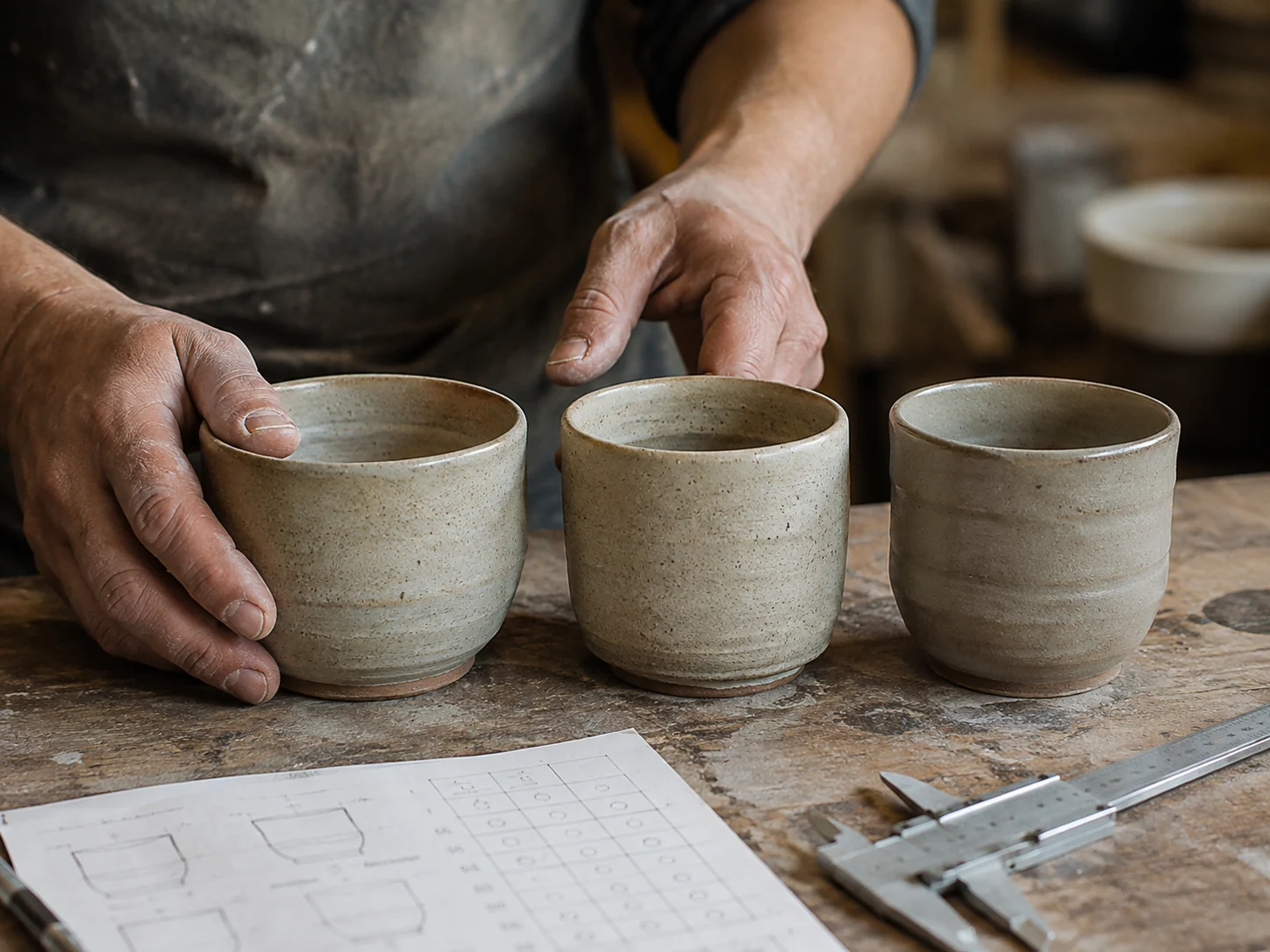
Consistency makes humanity trustworthy
Handmade should mean human judgment, not random outcomes. Define the sensory and functional details that must remain stable and the natural variation customers can expect. Keep a retained sample, a batch record, a current product specification, and a short final inspection. When something changes, record the reason rather than editing history. This is how a one-person studio develops institutional memory. It also makes a beautiful story credible: the customer sees that care is supported by discipline, not left to whatever the maker remembers after a long day.
Provenance is a chain, not a paragraph
Origin stories become fragile when they depend on broad claims. Trace the ingredients, components, people, and places that materially shape the product. Save supplier documentation. Know which substitutions require customer communication. If a claim matters—local, natural, recycled, small-batch, allergy-aware, fair trade—define exactly what it means and retain the evidence. Do not inflate a good story into a claim you cannot support. Precise provenance is less dramatic than vague romance, but it survives scrutiny and gives retailers, collaborators, and loyal customers something real to repeat.
Build a brand people can participate in
The maker does not need to become a full-time personality. Participation can be quieter: letting customers vote between two tested seasonal directions, inviting them to a studio demonstration, sharing care and repair guidance, or publishing the reasoning behind a discontinued item. The goal is not constant access to your private life. It is a relationship with the work. Set boundaries, choose a repeatable communication rhythm, and let customers witness improvement over time. A copied product appears from nowhere; a trusted maker has a visible history.
Turn the idea into a seven-day experiment
Insight becomes useful when it changes a real decision. Choose one current product, not the whole catalog. On day one, write the customer moment, the exact promise, the normal selling price, and the evidence you already have. On day two, calculate the complete unit cost with actual yield, packaging, labor, selling fees, and expected waste. On day three, map the work from purchased material to delivered order and mark the point most likely to delay, confuse, or damage the outcome.
Use days four and five to create one small improvement. It might be a clearer offer, a locked formula revision, a simpler packout, a retained reference sample, a reorder point, or a five-step quality check. On day six, put it in front of a real buyer or run it through a real batch. On day seven, record what happened and decide whether to keep, revise, or stop. A seven-day experiment is not supposed to solve the entire business. It should replace one assumption with evidence.
The numbers that keep the story honest
Track only measures connected to the decision: sellable yield, complete unit cost, contribution per unit, hands-on minutes, conversion, repeat demand, defect or replacement rate, and cash committed to stock. A high-view post can be valuable, but it is not proof of profitable demand. A sellout can be exciting, but it may indicate a price, capacity, or forecasting problem. Put the operational number beside the audience number so neither gets to tell the story alone.
Review the result under normal conditions. Remove launch gifts, unusually cheap materials, donated labor, and best-case yield. Ask what happens when the batch is slightly slow, a supplier raises prices, or one in twenty units needs rework. Resilience is not pessimism. It is the difference between a product that photographs well and one the business can responsibly promise again.
A simple founder review
Once a week, answer five questions in writing:
- What did customers actually choose, repeat, or decline?
- Which product created the healthiest contribution for the time it used?
- Where did work wait, fail, or require the founder to rescue it?
- Which material or commitment could interrupt the next two weeks?
- What is the single decision that would make the next cycle simpler?
Keep the review short enough to continue through busy periods. Over time, these notes become an advantage no trend report or competitor can copy: a record of how your specific customers, products, and process behave.
Build the smallest system that protects the promise
A system can begin as a printed checklist, a labeled bin, a cost sheet, or a scheduled review. It becomes valuable when it is current, visible, and connected to action. Define who updates it, when it changes, and what decision it controls. If a field is never used, remove it. If the same surprise occurs twice, give it a place in the workflow.
As orders, materials, revisions, and people multiply, disconnected sheets become harder to maintain. That is the point at which a connected workspace can return meaningful time. Batch Scale is designed to connect costing, inventory, recipes and formulas, production, purchasing, orders, and workflows, but software should support a clear method rather than conceal an unclear one. Start with the decision. Add structure in proportion to the risk.
Questions to ask before you scale the idea
First, ask whether the customer value is specific enough to survive growth. Which detail would buyers notice if it disappeared? Which detail is expensive but invisible? What promise is being made by the photograph, description, sample, or sales conversation? Write those answers into the product specification and customer-facing language. Scaling an undefined promise usually produces more units and more disagreement at the same time.
Second, ask what the next ten orders require in cash and time before thinking about the next thousand. List every material, component, approval, production hour, waiting period, inspection, and delivery task. Mark the inputs with long lead times and the steps only one person can perform. If a surge arrived tomorrow, decide which offer would close, which date would move, and which customer message would be sent. Boundaries chosen in advance are far kinder than apologies improvised after an overcommitment.
Third, ask what must be recorded for the business to learn. At minimum, capture the current version, planned and actual quantity, sellable yield, material lots where relevant, hands-on time, exceptions, defects, and customer response. Do not collect data for decoration. Each field should support a decision about price, purchasing, capacity, quality, or demand. A small, consistently maintained record is more valuable than an impressive dashboard populated only before a launch.
Finally, ask what would make you stop or revise the idea. Define the acceptable investment, test period, margin, defect rate, and evidence of repeat demand before enthusiasm takes over. A stop rule does not predict failure; it protects enough cash and attention to run the next good experiment. Likewise, define the evidence that earns expansion: repeated full-price orders, stable quality, a funded production cycle, and a process that does not depend on emergency labor.
How this looks in different maker businesses
For a coffee roaster, the decision might be whether a limited-origin release can maintain roast consistency and enough contribution after green-coffee cost and small-run packaging. For a candle or soap studio, it may be whether a new scent deserves its own vessels, labels, safety documentation, and permanent shelf space. A baker may need to compare the visual appeal of a custom item with the decorating hours and delivery risk it creates. A spice maker may discover that the strongest blend is limited by one imported ingredient rather than demand.
The product changes, but the operating questions remain remarkably stable: What exactly did we promise? What does a sellable unit truly cost? Which resource limits safe, on-time output? What evidence justifies buying or making more? And what record will help the next batch improve? Answering those questions turns a creative idea into a product the business can stand behind.
The bottom line
Makers do not need to become miniature corporations. They need enough operational clarity to protect the human work customers value. The most durable businesses pair a memorable product with complete numbers, repeatable quality, honest capacity, and a learning rhythm. Choose one action from this article, attach it to a product and a date, and finish it before adding another idea. Progress becomes scalable when the business can remember what the founder learned.
Sources and further reading
Explore the complete library of free tools for makers or see how Batch Scale connects the work.