
Costing & Pricing
The Hero SKU Test: Find the Product That Can Actually Carry Your Business
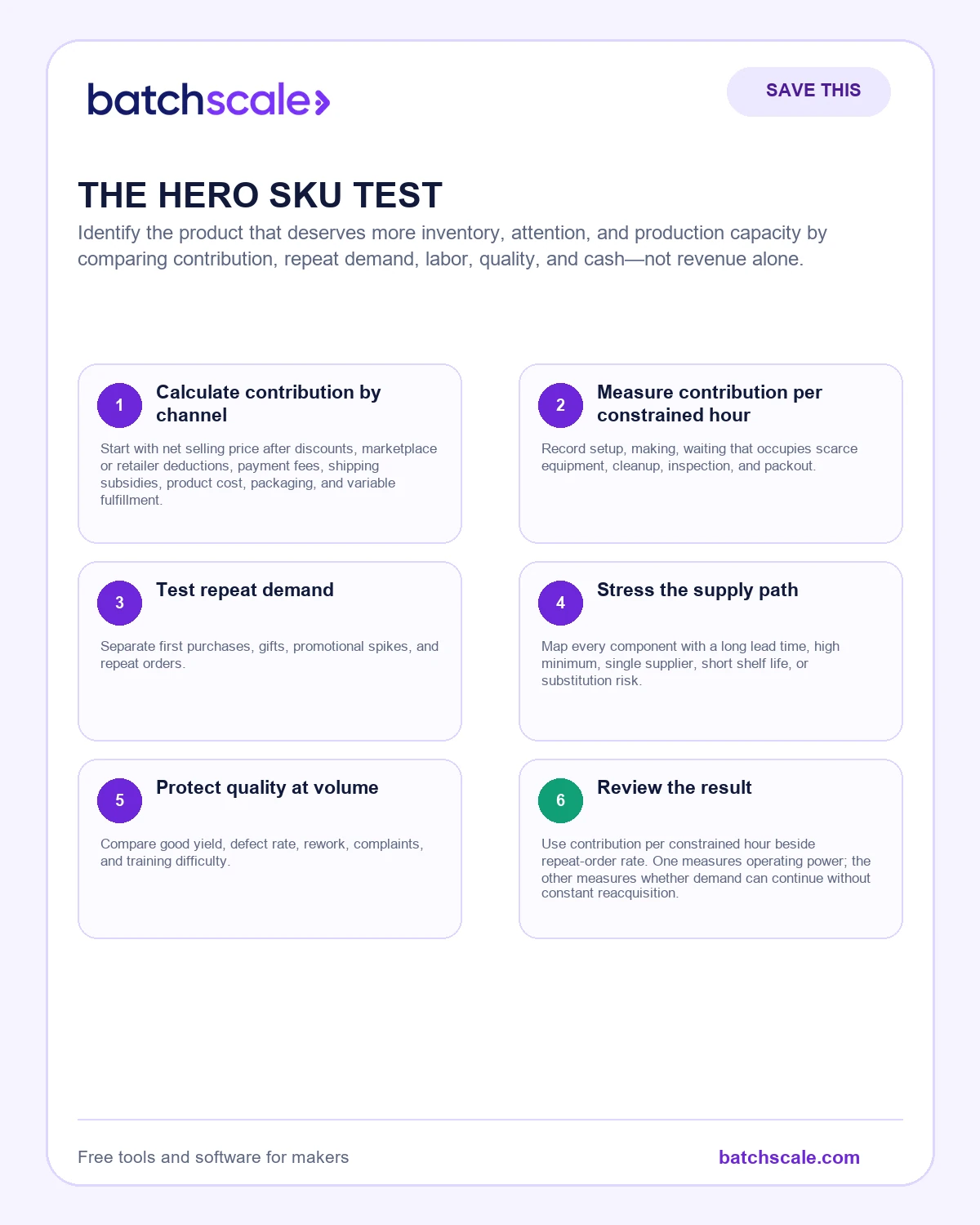
Identify the product that deserves more inventory, attention, and production capacity by comparing contribution, repeat demand, labor, quality, and cash—not revenue alone.
Every growing product business eventually wants a hero: the candle customers name to friends, the spice blend retailers reorder, or the kit that makes the brand easy to understand. The mistake is declaring the highest-revenue item the winner before asking what it consumes.
A real hero SKU earns healthy contribution after its complete costs, uses constrained labor well, survives normal variation, replenishes without drama, and gives customers a reason to return. It should simplify the business as volume grows. If success creates emergency buying, overtime, defects, and cash shortages, the product may be famous without being structurally strong.
The test below replaces instinct with a balanced comparison. It does not eliminate creative judgment. It shows where judgment can create durable value instead of financing a bestseller that quietly weakens everything around it.
The quick answer
The outcome is a clear investment order: one hero to keep available, a supporting assortment that strengthens it, and products that remain seasonal, experimental, or ready to retire. Begin with Capture ninety days of unit sales, net revenue, complete variable cost, labor time, good yield, stockouts, and repeat orders for every serious candidate. The first operating priorities are calculate contribution by channel and measure contribution per constrained hour; the working system then has to support test repeat demand, stress the supply path, protect quality at volume. Keep the scope narrow enough that the decision can be tested with real evidence instead of debated through general opinions.
What this looks like in a real maker business
A sauce company assumes its hottest flavor is the hero because it produces one third of sales. The full review shows that its imported bottle has the longest lead time, the filling step is twice as slow, and promotions drive most purchases. A quieter core sauce produces slightly less revenue but earns more contribution per bottling hour, generates stronger second orders, and shares packaging with two other products. The company keeps the famous flavor, but plans inventory and marketing around the product that can reliably carry growth.

The practical playbook
Calculate contribution by channel
Start with net selling price after discounts, marketplace or retailer deductions, payment fees, shipping subsidies, product cost, packaging, and variable fulfillment. Compare direct, wholesale, event, and subscription orders separately because one blended margin can hide a weak channel.
Put it to work: Run each candidate through the product mix optimizer using a normal month rather than the best launch week.
Measure contribution per constrained hour
Record setup, making, waiting that occupies scarce equipment, cleanup, inspection, and packout. Divide contribution by the hours of the person or station that limits output. This reveals products that look profitable per unit but crowd out better work.
Put it to work: Time one representative batch from staging through release and label estimates honestly.
Test repeat demand
Separate first purchases, gifts, promotional spikes, and repeat orders. A hero does not need a subscription cadence, but customers should understand when and why to buy again. Reorder behavior is stronger evidence than likes or launch-day traffic.
Put it to work: Track the first-to-second-order rate and median days to reorder for each candidate.
Stress the supply path
Map every component with a long lead time, high minimum, single supplier, short shelf life, or substitution risk. A hero SKU deserves a supply plan that can absorb ordinary disruption without lowering the specification.
Put it to work: Model the next two replenishment cycles and identify the first component likely to stop production.
Protect quality at volume
Compare good yield, defect rate, rework, complaints, and training difficulty. The product must remain recognizable when another trained person follows the method and when batch size increases within validated limits.
Put it to work: Run a controlled scale test and compare the result with an approved sample and written specification.
What can go wrong
Do not crown a product because it has the best margin percentage, biggest order, or strongest social post. A small high-margin item may contribute too few dollars; a large order may create a cash gap; a viral product may have no repeat use. Keep the scorecard connected to actual orders and batches.
A useful safeguard is to keep the original source record beside the interpretation. If an order, count, supplier date, batch result, customer message, or payment changes, update the decision and preserve why it changed. This prevents a confident dashboard from drifting away from the physical business.
The number that keeps this honest
Use contribution per constrained hour beside repeat-order rate. One measures operating power; the other measures whether demand can continue without constant reacquisition.
Use the number as a decision signal, not a performance weapon. Review the definition, compare similar periods, and pair it with quality and customer evidence. A metric becomes dangerous when people improve the displayed result by moving work, cost, or failure outside the measurement.
A simple 30-day implementation
Week 1: establish the baseline
Gather the records described above and keep uncertainty visible. Use actual orders, batches, counts, supplier confirmations, and payment records wherever possible. Mark estimates instead of polishing them into false facts. Choose one product, channel, or workflow narrow enough to finish in a week. A completed small baseline teaches more than a company-wide workbook nobody trusts.
Week 2: change one operating rule
Translate the first two playbook steps into a rule with an owner, trigger, input, decision, and expected output. Save the previous method. Explain the change to everyone whose work or promise is affected. If the rule touches safety, compliance, employment, tax, contracts, or regulated claims, pause for qualified guidance before using a general article as authority.
Week 3: run the rule in real work
Use the rule through a normal cycle. Record exceptions when they happen; do not repair the record after the fact. Keep customer commitments and required controls intact. One exception may be ordinary variation. Repeated exceptions usually mean the threshold, instruction, source data, authority, or capacity assumption needs revision.
Week 4: review the evidence
Compare the baseline with the metric in this guide. Ask what improved, what moved somewhere else, and what new burden appeared. Keep the rule, revise it, or remove it. Write the decision, owner, and next review date. That short history becomes operating memory and prevents the same debate from restarting whenever the founder is tired.
When connected software becomes useful
Spreadsheets and checklists are excellent for learning a method. They become fragile when the same product, formula, material, batch, order, customer, and cost must be updated in several places. Duplicate entry creates version disagreement; delayed entry makes reports look precise while the floor works from different facts.
Connected software should not automate confusion. It should preserve the current product version, show available and committed inventory, connect production with actual material and yield, carry costs into channel decisions, record who changed what, and make exceptions visible. Start with the decision that currently requires the most reconciliation. Add the next workflow only after the first source of truth is dependable.
Questions to ask before you scale the change
- Can a trained person explain the rule and the reason behind it?
- Is the required source data available at the moment the decision is made?
- Does the rule protect product quality, customer expectations, and applicable obligations?
- What evidence would prove the change is helping rather than moving cost elsewhere?
- Who owns an exception, and how quickly must they respond?
- Can the business export the records and reconstruct what happened later?
Growth becomes calmer when decisions leave a trail. The objective is not more administration. It is fewer avoidable surprises and a business that can repeat what works.
Related tools and reading
The bottom line
The outcome is a clear investment order: one hero to keep available, a supporting assortment that strengthens it, and products that remain seasonal, experimental, or ready to retire. Choose one product or workflow, establish the baseline, and make one observable change. Review the result after a real cycle. Clear evidence, a responsible owner, and a next review date will outperform a dramatic overhaul that the business cannot sustain.
Explore all free tools for makers, browse the Batch Scale resource center, or see how Batch Scale connects costing, inventory, production, orders, and customers.